
Reviewed by Dr. Chandana Lakkireddy
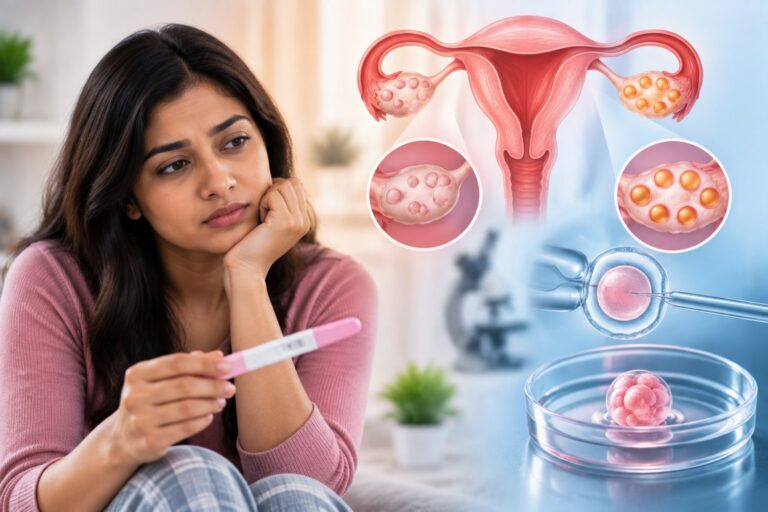
Starting IVF treatment can bring many questions for couples. How long do IVF injections last? When does egg retrieval happen? How are embryos developed? When is the embryo transferred?
Understanding the IVF treatment timeline can help you prepare for each stage with greater confidence.
In Vitro Fertilisation (IVF) is a fertility treatment in which eggs are collected from the ovaries, fertilised with sperm in a specialised laboratory, and the resulting embryo is transferred into the uterus.
Let’s understand the IVF process step by step.
How Long Does the IVF Process Take?
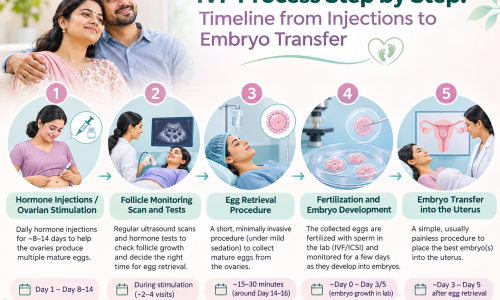
A typical IVF cycle involves several stages, from ovarian stimulation to embryo transfer. A fresh IVF cycle may take approximately 2–3 weeks from the beginning of stimulation to transfer. Additional time may be needed for initial assessments or frozen embryo transfer.
Step-by-Step IVF Treatment Timeline
1. Initial Fertility Assessment
Before starting IVF, the fertility specialist evaluates both partners. This may include hormonal blood tests, ultrasound scans, ovarian reserve assessment and semen analysis.
Based on the results, the doctor creates an individualised IVF treatment plan.
2. Ovarian Stimulation – IVF Injections
The next stage involves daily hormone injections to stimulate the ovaries to develop multiple follicles instead of the single egg usually released during a natural cycle.
This stage generally lasts around 8–14 days.
Regular ultrasound scans and blood tests help monitor follicle growth and determine the right time for egg retrieval.
3. Trigger Injection
Once the follicles are ready, a trigger injection is given to support final egg maturation.
Egg retrieval is usually scheduled approximately 34–36 hours after this injection.
4. Egg Retrieval
Egg retrieval is a minor procedure performed under ultrasound guidance, usually with sedation.
A fine needle is used to collect eggs from the ovarian follicles. The collected eggs are then examined by the embryology team.
5. Fertilisation
The collected eggs are combined with prepared sperm in the IVF laboratory.
Fertilisation may happen through conventional IVF or ICSI (Intracytoplasmic Sperm Injection), depending on the couple’s medical condition.
The embryology team checks the eggs for successful fertilisation.
6. Embryo Development
After fertilisation, embryos are monitored in a specialised laboratory for approximately 3–5 days, sometimes up to Day 6.
The embryologists assess embryo development and quality. Suitable embryos may be selected for transfer, while other suitable embryos can be frozen for future use.
7. Embryo Transfer
Embryo transfer is the stage where the selected embryo is gently placed into the uterus using a thin, flexible catheter.
It is generally a short procedure and usually does not require anaesthesia.
Depending on the patient’s medical condition, embryo transfer may be performed during the same cycle (fresh transfer) or in a later cycle (frozen embryo transfer).
8. Pregnancy Test After Embryo Transfer
After embryo transfer, patients are advised to continue prescribed medications and follow their fertility specialist’s instructions.
A Beta-hCG blood test is generally performed around 9–14 days after transfer, depending on the treatment protocol, to check for pregnancy.
Fresh vs Frozen Embryo Transfer: What’s the Difference?
Fresh Embryo Transfer: The embryo is transferred into the uterus during the same IVF stimulation cycle, usually 3–5 days after egg retrieval.
Frozen Embryo Transfer (FET): A previously frozen embryo is transferred during a later cycle after preparing the uterine lining.
The most suitable approach depends on individual medical factors and the fertility specialist’s recommendation.
Frequently Asked Questions About IVF
1. How many days do IVF injections last?
IVF stimulation injections generally continue for 8–14 days, depending on ovarian response and the treatment protocol.
2. How many days after the trigger injection is egg retrieval performed?
Egg retrieval is usually scheduled approximately 34–36 hours after the trigger injection.
3. On which day is an embryo transferred?
Embryo transfer commonly takes place on Day 3 or Day 5 after egg retrieval, depending on embryo development and the treatment plan.
4. Is embryo transfer painful?
Most women experience little or no discomfort during embryo transfer. It is generally a simple procedure that does not require anaesthesia.
5. When can I take a pregnancy test after embryo transfer?
A Beta-hCG blood test is generally recommended around 9–14 days after embryo transfer, according to your doctor’s instructions.
Begin Your IVF Journey with Expert Guidance
Every fertility journey is unique. Understanding the IVF treatment process can help couples feel more informed and prepared at every stage.
At Esha IVF Fertility Center, we focus on personalised fertility care, guiding couples through their IVF journey with medical expertise and compassionate support.
If you are considering IVF treatment, consult a fertility specialist to understand the right treatment options for you.
Book Your Fertility Consultation Today
Esha IVF Fertility Center
Banjara Hills | Khajaguda, Hyderabad
Contact: 7798983333
Medical Review:
Dr. Chandana Lakkireddy
Senior Infertility Consultant & Founder
Esha IVF Fertility Center
Disclaimer: This article is for educational purposes only and does not replace individual medical advice. IVF timelines and treatment protocols may vary between patients.